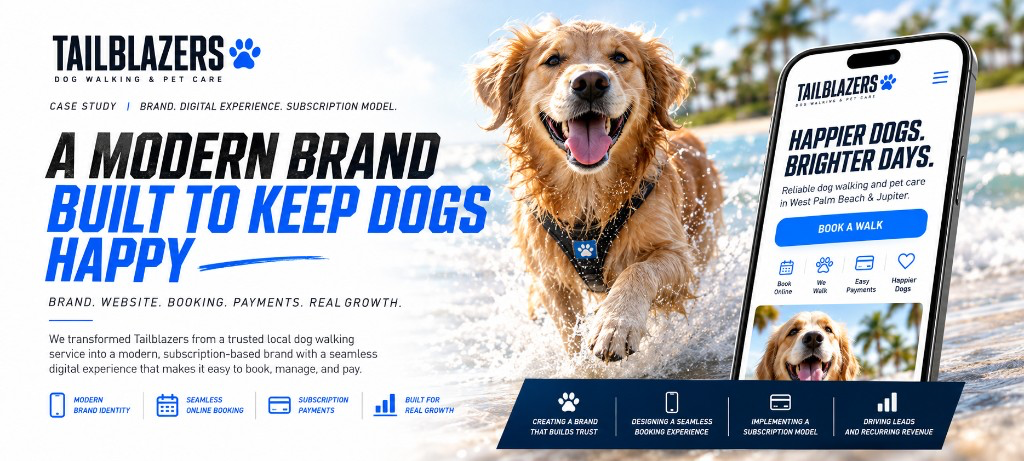
We didn't just redesign the website. We redesigned the business behind it.
A premium dog-walking service in Jupiter and Palm Beach Gardens, running on Greg's reputation and a business card. The work built a brand, a digital experience, and a subscription system around a service that was already trusted.
Product Strategy · UX · Business Model · Service Design · AI-Enabled Development
RoleProduct strategy, UX, and business-model design for Tailblazers, a privately owned premium dog-walking service in Jupiter and Palm Beach Gardens. Greg operates the business.
Business ChallengeThe business ran on a card, reputation, and referrals. A trusted service had no digital acquisition path, productized offer, or recurring-revenue infrastructure around it.
Leadership ResponseBuilt the system around the trust Greg had already earned — brand, digital experience, a productized offer, and subscription infrastructure — rather than replacing the service.
OutcomeA productized offer, a designed acquisition journey, and a foundation for recurring revenue. The work is still evolving. No performance metrics are published.
Executive SignalShows a design leader treating the business model as part of the experience, and staying in the work from strategy through working software.
The business
The starting point wasn't an outdated website. It was a business card.
Tailblazers is a privately owned dog-walking business serving Jupiter and Palm Beach Gardens. When this project began, it was operating from a business card, Greg's reputation, referrals, personal relationships, and direct communication. There was no digital business to refresh.
Greg had already built the trust. We built the system around it.
The hardest part was already done. Tailblazers had a premium service, loyal relationships, referrals, and a strong reputation. Operating that way is evidence the service had value. What it did not have was the infrastructure around that service.
A digital acquisition funnel
A productized recurring offering
A subscription model
Recurring billing infrastructure
A connected digital customer journey
The job was not to replace what Greg had built. It was to give a proven personal business a modern system capable of supporting growth.
The build
Business card
↓Brand
↓Digital experience
↓Productized service
↓Tailblazer 2 / 3 / 5
↓Subscription model
↓Recurring-revenue infrastructure
Homepage
On a phone
How the relationship actually worked
A referral, a conversation, a walk, a payment. Premium care, an experienced owner-operator, and real relationships in affluent neighborhoods. The commercial rhythm was still a transaction, carried by people rather than by a product.
Book
→Walk
→Pay
→Repeat
That loop is easy to understand and expensive to grow. Every walk restarts the relationship.
Premium personal service
Trust
An experienced owner-operator
Strong customer relationships
Affluent service areas
A genuinely useful service
The insight
The breakthrough wasn't a better booking form.
It was changing what customers were buying.
Before
“Book Greg when I need a dog walker.”
After
“Tailblazers is part of how my dog is cared for every week.”
Individual walks can still happen. The experience is designed so the primary offer is an ongoing relationship — closer to a service product than a series of one-off jobs.
The decision behind the model
What Was HappeningTailblazers is a privately owned premium dog-walking business serving Jupiter and Palm Beach Gardens. When the project began, it was operating from a business card, Greg's reputation, referrals, and direct contact. The service and the trust were already strong. The commercial rhythm was still a transaction: book a walk, pay, and start again.
My MandateI led the product strategy, UX, business-model design, and the build of the customer experience. Greg operates the business. I do not own it.
The ProblemThe obvious brief was a website: publish the service and add a booking form. There was no outdated site to replace. A brochure would have put the existing model online. It would not have built a system around the trust Greg had already earned, or changed what the customer was buying.
The Decision I MadeI redesigned the commercial relationship. Customers choose Tailblazer 2, Tailblazer 3, or Tailblazer 5 — two, three, or five walks a week — and enter a subscription. The website is the operating layer for acquisition, a meeting with Greg, scheduling, and recurring billing.
What I Chose Not to DoRejected a brochure website, and rejected treating the work as a refresh of a digital business that was not there.
Why That Tradeoff Was CorrectGreg had already built the trust. The design job was to build the system around it, so a proven personal business could support growth. A plan changes the default from “book Greg when I need a walker” to “Tailblazers is part of how my dog is cared for every week,” which is what makes capacity, retention, and revenue possible to plan.
Organizational InfluenceThe work changed how the business sells, schedules, and gets paid. The customer experience and the operating model were designed together, with Greg’s time protected for care rather than for restarting every sale.
What ChangedWeekly plans, a journey from discovery through meeting Greg to subscription, and a technical foundation for leads, scheduling, and recurring billing. The project is still evolving. No revenue, subscriber, conversion, or retention figures are published.
The model
Redesigning the business model
There was no website to replace. The digital experience was built as part of how Tailblazers acquires a customer, qualifies them, and keeps them.
Before
Lead
Contact
Schedule
Walk
Payment
Start again
After
Marketing
Landing experience
Qualified lead
Meet Greg
Choose plan
Subscription
Recurring service
Recurring billing
Retention
Marketing, the first screen, the meeting with Greg, the plan, the subscription, the walk, and the next invoice are one system.
Turning walks into a product
Customers are no longer handed an informal list of services. They choose Tailblazer 2, Tailblazer 3, or Tailblazer 5 — two, three, or five walks a week.
Tailblazer 2
2
walks / week
Tailblazer 3
3
walks / week
Tailblazer 5
5
walks / week
Tailblazer 2, 3, and 5
The important decision is not a price. It is the shift from buying an individual service to choosing an ongoing level of service. That structure is what makes the business easier to buy, run, and keep.
Clearer purchasing decisions
Easier comparison
Repeat behavior
Less booking friction
Stronger retention
Predictable capacity
Recurring revenue
Higher lifetime value
A conversion system, not a brochure
The path is one sequence: discovery, trust, understanding, a conversation with Greg, a plan, a subscription, and a relationship that continues.
01
Discovery
The service area is obvious before anything else is asked.
02
Trust
Premium and approachable, carried by photography of happy dogs.
03
Understanding
Services are plain, pricing is transparent, and the next step is clear.
04
Meet Greg
A scheduled conversation with the person who will care for the dog.
05
Choose plan
An ongoing level of service, not a one-off walk.
06
Subscribe
Recurring checkout, with the anxiety taken out of the decision.
07
Ongoing care
Onboarding into a relationship that repeats every week.
FAQs, lead capture, and a mobile-first layout keep that path short on a phone. The page has a job: move a qualified customer into a plan.
Service area
Meet Greg
Booking on a phone
The system
A modern premium service
The visual language moves Tailblazers away from the casual neighborhood dog walker. White space, charcoal type, a single electric blue, bold condensed display type, and photography of dogs that look glad to be out. Hierarchy is obvious. Pricing is simple. The tone is premium and friendly, and it has to hold up on a phone.
White environments
Charcoal typography
One electric blue
Bold condensed display type
Energetic dog photography
Simple, confident pricing
Services and pricing
The visual redesign supports the business redesign. It is not the whole story.
Designing the economics, not just the interface
Product decisions were checked against how Tailblazers could acquire customers, retain them, service them, and earn recurring revenue it can plan around. Private commercial terms stay private. No results are invented here.
Recurring revenue
The offer is built to continue, not to be resold after every walk.
Customer lifetime value
A weekly plan is worth more than a single visit, so the relationship is designed to last.
Customer acquisition
The landing experience qualifies demand before Greg’s time is spent.
Paid marketing
There is a destination built for paid traffic, not only word of mouth.
Infrastructure
Leads, scheduling, and billing sit inside the product.
Subscription retention
The default is staying on a plan, not rebooking from scratch.
Capacity planning
Weekly plans make the route knowable.
Predictable scheduling
Recurring visits replace one-off coordination.
Scalable acquisition
The funnel can take more demand without rebuilding the sale each time.
The website became an operating layer
The customer-facing experience connects to infrastructure for acquisition and recurring revenue. The platform includes, or is being built around, the pieces below. They matter because the relationship has to keep running after the first yes.
The experience people buy through
Next.js and TypeScript carry a responsive front end, SEO, and structured data, so discovery and the landing experience live in the same system.
A record of every lead
Supabase holds leads and appointments. Server-side handling and webhooks keep a conversation with Greg from disappearing into a personal inbox.
Revenue that continues
Stripe, Stripe Checkout, and subscription management turn a chosen plan into billing that does not restart the sale.
A base for paid growth
Scheduling in the journey, a conversion-tracking foundation, and a marketing-attribution foundation give acquisition something measurable to plug into. Deployment is built to scale with volume.
The website is the operating layer for customer acquisition and recurring revenue.
From a decision to working software
The same practice designing the offer was in the work of making it real. Strategy, UX, interface, architecture, code, testing, and the next revision ran as one loop, not a chain of handoffs.
Strategy
→UX
→Interface
→Architecture
→Code
→Testing
→Iteration
AI compressed the distance between an idea, a design decision, and working software. The project shows a design leader moving through strategy, product, UX, visual design, business logic, and implementation without dropping the thread.
The shift
From a service business to a service product
Before
A service business
One-off transactions
Manual lead handling
Repeat booking friction
Less predictable revenue
Disconnected processes
Website as marketing collateral
After
A service product
Recurring subscriptions
Structured acquisition funnel
Automated payments
Recurring revenue model
Connected customer journey
Website as business infrastructure
What this made possible
The project is still evolving. Nothing below is a performance claim. These are capabilities the business now has a foundation for. A measured result can sit on the same card when one exists.
Recurring-revenue model established
Service offering productized
Subscription billing architecture created
Customer acquisition funnel designed
Lead tracking centralized
Scheduling integrated into the journey
Brand established around the existing reputation
Customer journey redesigned
Technical foundation established
Infrastructure created for paid acquisition
What this project demonstrates
The most valuable design decision wasn't a color, component, or page. It was recognizing that the business model itself was part of the user experience.
Tailblazers is what happens when UX, product strategy, technology, marketing, and business design are one practice. A small premium service can behave like a modern product company — a clear offer, a designed journey, recurring relationships, measurable acquisition, and revenue that can be planned.