


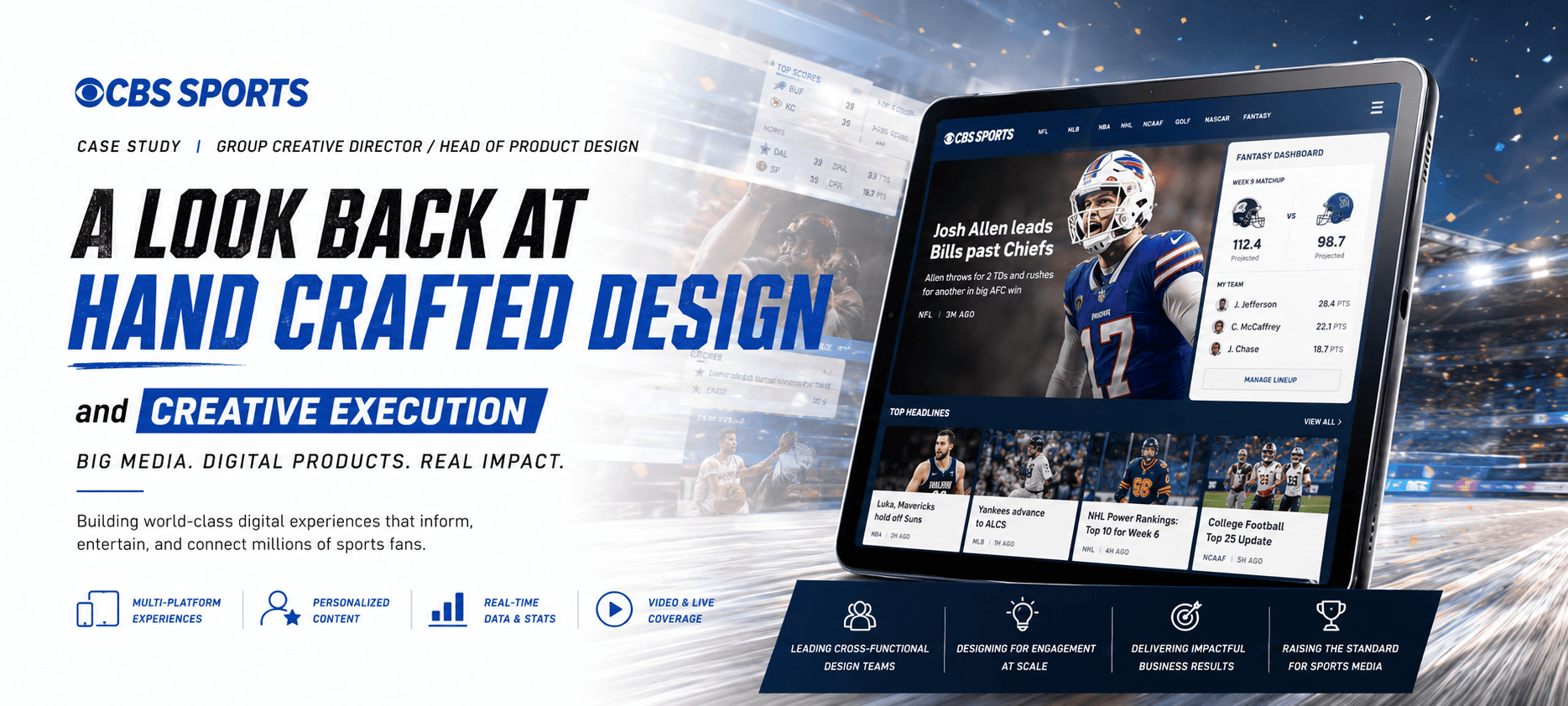
Hand Crafted Design & Creative Execution
Enterprise product and digital leadership.RoleDirector, User Experience (CBSSports.com), CBS Interactive (Aug 2011 – Jan 2014) — led product design and UX strategy for CBS Sports' audience-facing digital products.
Business ChallengeAging editorial and fantasy systems, a fast-shifting mobile audience with no dedicated design discipline, and free fantasy competitors threatening a premium subscription business.
Leadership ResponseModernized editorial and fantasy through distinct, purpose-built design systems, treated mobile as its own product discipline, and evolved fantasy through a deliberate sequence of conversion, social, and behavioral experiments rather than a single redesign.
OutcomeModernized editorial and fantasy through distinct design systems, treated mobile as its own product discipline, and evolved fantasy through a sequence of experiments. The team’s Super Bowl XLVII second-screen coverage set a record for online streaming of a single sporting event.
Executive SignalProves the ability to lead cross-functional teams (UX, editorial, engineering, broadcast) through competitive pressure at massive scale, choosing a sequenced-experiment strategy over a single high-risk bet.
Overview
Before AI products, SaaS platforms, and startup operating systems, I spent years solving a different kind of product challenge: helping millions of sports fans find, consume, and interact with information in real time. At CBS Sports, I helped lead product experience initiatives across one of the largest sports media platforms in the world—spanning user experience, product strategy, creative leadership, information architecture, audience engagement, mobile experiences, and large-scale event coverage.
Product Experience Leadership
UX Strategy
Information Architecture
CBS Sports.com
Fantasy Sports
GameTrackers
Mobile Products
Super Bowl XLVII
Special Events
Cross-functional Leadership
Editorial Collaboration
Sports Emmy–Winning Game of Honor
The Decisions Behind the Numbers
What Was HappeningCBS Sports operated one of the largest digital sports platforms in the world, competing for fantasy-sports and second-screen audience attention against a growing field of free fantasy products, while depending on a premium fantasy subscription business and modernizing editorial and fantasy systems that had grown over years.
My MandateAs Director, User Experience (CBSSports.com), I led product design, creative direction, and UX strategy for CBS Sports' audience-facing digital products, directing multidisciplinary teams across UX, visual design, editorial, and interactive development.
The ProblemEditorial and fantasy had grown into distinct, aging systems; mobile behavior was shifting fast and needed its own design discipline rather than a scaled-down web treatment; and free fantasy competitors threatened engagement with a premium product that depended on conversion and retention.
The Decision I MadeRather than one large, one-time redesign, we modernized editorial and fantasy through related but distinct design systems built for how each audience actually behaved, treated mobile as its own product discipline instead of a responsive afterthought, and evolved fantasy sports through a deliberate sequence of experiments — conversion-funnel redesign, socialization features, and behavioral improvements — rather than betting everything on a single relaunch.
What I Chose Not to DoRejected a single unified redesign that would have treated editorial and fantasy as the same problem, and rejected treating mobile as a scaled-down version of the desktop experience.
Why That Tradeoff Was CorrectSports fans move between editorial, live scores, and fantasy in fundamentally different behavioral patterns; forcing one system to serve all of them would have compromised speed and clarity for the highest-engagement use case. Sequencing fantasy improvements as experiments — rather than one redesign — reduced the risk of a single bet failing to move the needle against well-funded free competitors.
Organizational InfluenceDirected multidisciplinary teams across UX, visual design, editorial, and interactive development, collaborating with executives, product managers, engineers, and editorial and broadcast leadership to align teams whose incentives didn't naturally point the same direction — editorial velocity, advertising requirements, and engineering constraints all moving at once.
What ChangedDistinct, purpose-built design systems for editorial and fantasy; a native mobile product discipline; and a fantasy experience shaped by a running sequence of conversion, social, and behavioral experiments rather than a single static redesign.
Measured OutcomeFantasy was modernized through a deliberate sequence of conversion, socialization, and behaviour experiments rather than a single relaunch.
The Opportunity
The challenge was not creating a single product but a connected ecosystem serving millions of users across web, mobile, fantasy sports, live game experiences, editorial content, and championship events—helping fans find what matters most when thousands of pieces of content, scores, statistics, stories, videos, and fantasy updates change in real time. That work became the foundation of my approach to product leadership.
Sports fans consume information differently than almost any other audience. They move rapidly between breaking news, live scores, fantasy lineups, statistical analysis, video highlights, social conversations, and event coverage—often beginning on the homepage, jumping into Fantasy Football, checking a GameTracker, reading an injury report, watching a highlight package, and returning later to adjust a lineup. Every touchpoint needed to feel connected while balancing the needs of editorial teams, advertising partners, product stakeholders, engineering teams, league requirements, business goals, and millions of sports fans.
Product Vision
One of the most important strategic shifts was viewing CBS Sports not as a collection of pages but as a connected product ecosystem. Rather than optimizing individual destinations independently, we focused on how users moved between experiences to create a unified sports platform where content, utility, and engagement worked together.
That approach influenced navigation systems, information architecture, content discovery, advertising experiences, and product roadmaps across multiple properties.
CBS Sports.com
CBS Sports.com served as the front door to the entire ecosystem. The challenge was helping users navigate an enormous volume of content without feeling overwhelmed—through homepage experience strategy, navigation architecture, editorial presentation systems, sports section organization, breaking news experiences, mobile optimization, advertising integration, and audience engagement initiatives. Every design decision had to support both business objectives and user needs while accommodating one of the busiest editorial operations in digital media.
Editorial Experience
Stats Experience
GameTracker was one of CBS Sports' signature products and one of the most widely used live sports experiences on the platform—a second-screen experience for millions of fans while games were happening. The challenge was making large volumes of rapidly changing information understandable at a glance.
Commercial Experience
Advertising integration had to feel native to the editorial experience—supporting business objectives without compromising the speed and clarity fans expected from a live sports destination.
Fantasy Sports
Fantasy Sports represented one of the most passionate and engaged audiences within the CBS Sports ecosystem. Unlike editorial products that might attract occasional visitors, Fantasy users returned constantly throughout the season and needed powerful functionality without sacrificing speed or clarity.
We focused on draft experiences, roster management, league administration, trade workflows, lineup optimization, statistical presentation, mobile fantasy experiences, and seasonal retention—reducing friction so users could make confident decisions faster.
Fantasy Sports became one of the clearest examples of behavior-driven product design in action long before I formally studied behavioral design methodologies.
Mobile Transformation
During my tenure, consumer behavior began shifting dramatically toward mobile devices. This was not simply a responsive design problem—it required rethinking how sports fans consumed information while on the move.
We built for native iOS, real-time data, roster and league management, player analytics, push notifications, and touch-first interaction—with mobile-first workflows, simplified navigation, faster access to scores and updates, cross-device continuity, and performance optimization. The goal was to ensure fans could access critical information within seconds, regardless of device or connection speed.
Super Bowl XLVII
Few digital events generate the volume, attention, and expectations of the Super Bowl. For Super Bowl XLVII, CBS Sports delivered comprehensive digital coverage while ensuring every system, workflow, and experience could perform under extraordinary traffic demands.
Breaking news, live scoring, statistics, editorial content, video experiences, fantasy integrations, and real-time updates—all operating at a scale where millions of users depend on the platform throughout the event. Success required collaboration across product, engineering, editorial, marketing, advertising, and operations teams.
Sports Emmy–Winning Work
Of all the projects I worked on at CBS Sports, The Game of Honor remains one of the most meaningful—a digital storytelling experience honoring military service members and veterans through sports, video, editorial content, and audience engagement.
Unlike traditional sports products focused on scores and statistics, Game of Honor focused on human stories. The challenge was creating an experience that felt respectful, authentic, and emotionally powerful.
Working alongside talented creative, editorial, production, and technology teams, we brought the project to life as an integrated digital experience that earned an Emmy Award and demonstrated how thoughtful product work can create meaningful emotional connections with audiences.
“The most powerful product experiences are not always about utility—they are about human connection.”
Leadership
The most important work at CBS Sports rarely happened inside design files. Success depended on bringing together product teams, UX and design, engineering, editorial, marketing, advertising, and executive leadership—aligning priorities, managing complexity, and finding solutions that balanced audience needs with business goals.
This experience became foundational to how I lead product organizations today: product leadership across cross-functional teams, executive collaboration, and the discipline of shipping at scale when editorial velocity, advertising requirements, and engineering constraints all move at once.
Impact
- Helped shape product experiences used by millions of sports fans
- Led initiatives across multiple audience-facing platforms
- Supported large-scale live event coverage including Super Bowl XLVII
- Led the evolution of Fantasy Sports experiences
- Enhanced real-time sports engagement through GameTrackers
- Helped drive mobile product transformation
- At CBSSports.com, I conceived, designed, led, and published the Emmy-winning A Game of Honor digital experience
- Developed leadership practices that continue to influence my product work today
What I Learned
CBS Sports taught me that successful products are not collections of screens but systems that connect content, technology, business objectives, and human behavior into a cohesive experience.
The lessons from leading products there continue to influence how I build software today—from enterprise platforms and audience experiences to AI-powered products like Backline. The technologies have changed; the principles have not: understand the user, reduce friction, focus on the core loop, build for scale, and execute relentlessly.
At scale, the hardest problems are rarely interface problems alone. They are coordination problems—and the teams that win are the ones that align around the fan first.
What This Demonstrates
CBS Sports demonstrates leadership at the intersection of scale and competing incentives: aligning editorial, engineering, and broadcast teams whose priorities didn't naturally overlap, translating audience behavior directly into measurable business results, and choosing a sequence of validated experiments over a single high-risk redesign — the same discipline that still shapes how I evaluate product bets today.