

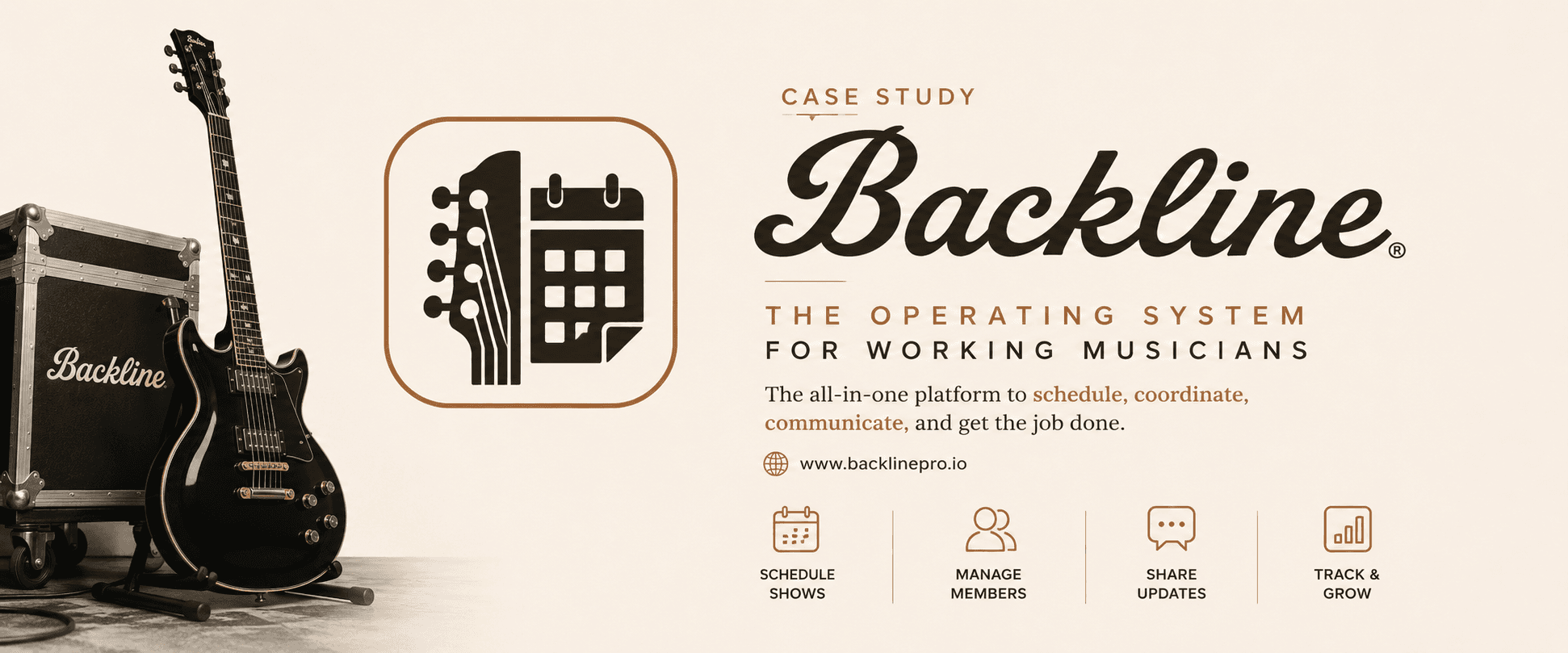
Turning Years on Stage into Better Product Experiences
Founder story, AI-assisted product development, and SaaS execution.RoleFounder & Product Lead at Backline (2026 – Present) — sole owner of product vision, systems architecture, and execution.
Business ChallengeWorking musicians had no single system for scheduling, availability, and communication — only disconnected calendars, chat apps, and email.
Leadership ResponseDesigned and shipped a connected operating system rather than a single-purpose utility, enforcing real workflow dependencies in the data model and sequencing onboarding and monetization around trust rather than feature count.
OutcomeConceived, designed, and shipped to production in 77 days—11 weeks, entirely AI-assisted, with every product and architecture decision made solo.
Executive SignalProves the ability to own an entire product — vision through execution — without a team to delegate to, applying enterprise-scale product judgment at founder speed.
Overview
Backline is the SaaS platform I founded to solve a problem I have lived inside for decades — not as a theorist, but as a musician, creative director, and industry consultant. Conceived, designed, and shipped to production in 77 days—11 weeks using AI-assisted product development, it brings scheduling, communication, availability, and organizational operations into one connected system.
Founder & Product Lead
UX Strategy
Information Architecture
Behavior Design
AI Product Engineering
Design Engineering
Systems Design
End-to-End Execution
The Decision Behind the Build
What Was HappeningWorking musicians and bands coordinate constantly, but the tools they use weren't built for it — schedules scatter across personal calendars, availability stays ambiguous, and communication fragments across group chats and email. I started Backline as a solo, AI-assisted founder with no existing team or playbook to follow.
My MandateAs founder, product lead, and AI product architect, I owned every decision — product vision, systems architecture, monetization, and execution — with no team to delegate any of it to.
The ProblemThe obvious path was to ship a single, focused utility — just a shared calendar, or just a chat tool — and expand later. That path is faster to build but leaves the fragmentation problem unsolved, since musicians would still need to stitch multiple disconnected tools together.
The Decision I MadeI designed Backline as a connected operating system instead — one system spanning product, brand, operations, infrastructure, and commercialization — and enforced the real workflow dependencies directly in the data model, such as requiring a setlist to exist before it can be attached to an event. New users move through a linear onboarding sequence before the full dashboard is revealed, and founding-tier access is kept separate from the ongoing Stripe-based commercial subscription model.
What I Chose Not to DoRejected shipping a single-purpose utility first, and rejected exposing the full dashboard's complexity to new users before they'd experienced the core loop.
Why That Tradeoff Was CorrectA founding musician needs to feel the product's value immediately, without being asked to commit financially or being overwhelmed by every feature at once. Sequencing trust and simplicity first protects both early adoption and long-term monetization discipline — and modeling real workflow dependencies in the data itself (not just the UI) keeps the product honest about how bands actually operate.
What ChangedBackline shipped as one coherent system rather than a collection of disconnected features, with an onboarding flow and access model reflecting how real working bands operate, and continues to evolve based on observed usage by real bands rather than a fixed roadmap.
Why Backline Exists
Musicians, bands, venues, and the professionals around them coordinate constantly — but schedules scatter across personal calendars, availability stays ambiguous, and communication fragments across group chats and email. Conflicts surface too late. Nobody shares a trustworthy record of what was decided.
"I have shipped products at scale for CBS Sports, Live Nation, and Ticketmaster — and I know what it feels like when a gig changes, a band member goes dark, and three threads disagree about what was confirmed."
The Problem We Set Out to Solve
General-purpose tools were never designed for this workflow. Working musicians need one system that connects planning, people, and communication — not another calendar app or another chat thread.
So how did I solve it?
Product Strategy
Rather than competing as a calendar app or a chat tool, Backline was positioned as the connective layer — the smallest set of capabilities that form a complete operating loop: plan, coordinate, communicate, confirm. Every diagram below is evidence for the same thesis: one system, one source of truth, one loop.
Here's What I Built
From concept to working software in 77 days—11 weeks — a mobile-first SaaS platform built for the pace of working musicians, not enterprise procurement cycles.
Coordinate
Every working week starts with the same question: what is happening, who is available, and what conflicts need resolving before they become crises?
Dashboard
A personalized command center surfaces upcoming performances, follow-ups, recent activity, and schedule conflicts — reducing the cognitive load of running a band.
Calendar, Availability & Blackouts
A shared, conflict-aware calendar keeps every band member aligned. Members block unavailable dates in real time — preventing booking conflicts before they happen.
Communicate
Coordination fails when conversations detach from the work. Backline ties messaging, notifications, and activity history to the events and groups they belong to.
Manage
Bands, venues, and permissions need structure without bureaucracy. Each group manages its identity, roster, and access from screens designed for clarity under pressure.
Grow
Sustainable products need sustainable onboarding and business models. First-run flows get bands operational in minutes; subscription tiers scale from individual artists to organizations.
Designed Around Real Workflows
Backline was designed around the real workflows of musicians, band leaders, managers, agents, and promoters. The milestones below are dated build facts, verified against the product database. Usage, satisfaction, and adoption figures are deliberately absent: none are published until real analytics support them.
AI Product Engineering
AI was leverage across the entire product lifecycle — accelerating research synthesis, design iteration, test coverage, and implementation — while product strategy, systems design, and execution decisions remained human-led.
What Backline Proved
Thirty years building audience-facing products for CBS Sports, Dominion, Live Nation, and Ticketmaster — combined with decades on stage as a working musician — gave Backline a rare foundation. Senior product leadership applied to a domain I understand from the inside.
The strategic bet held: define the smallest complete operating loop, ship it end to end, and expand from a system people can actually run their week on. AI handled volume across research, design, and implementation; I handled judgment on strategy, architecture, and experience quality.
Great products are not collections of features — they are systems that connect people, timing, and trust into a coherent experience. Backline proved that the same principles I applied at CBS Sports and Dominion apply equally when you are the founder shipping alone with AI as leverage.
77 days—11 weeks
Concept to productionFounder-Led
End-to-End OwnershipAI-Assisted
Human-Led Strategy & SystemsMobile-First
Built for Working MusiciansSaaS Platform
Artists · Bands · Venues · OrganizationsComplete Loop
Plan · Coordinate · Communicate · ConfirmSee it in production
Backline is not a concept deck. It is running software with real organizations on it.
What This Demonstrates
Backline shows what happens when product judgment meets AI-assisted execution with no team to fall back on: every decision — what to build, what to reject, how to sequence trust before monetization — was made under real ambiguity, with only the outcome to validate it. It's evidence that the same systems-thinking discipline that works at enterprise scale works just as well when you're the one shipping alone.