
For most of my career, I was the person in the room who could see the product clearly—strategy, UX, narrative, the whole thing—and then hand it off and hope it survived contact with reality.
Sometimes it did. Often it didn't.
The handoff problem
Handoffs are where good ideas go to get tired.
You lose context. You lose urgency. You lose the subtle decisions that only make sense when you've lived inside the problem. I got tired of watching that happen.
Learning by building—again
I've always learned by building. Web. Mobile. Design systems. Behavior design. Every wave, same pattern: get my hands dirty, make mistakes, ship something, get better.
AI is that wave—just faster and weirder.
I started treating AI less like a magic box and more like a shop full of power tools. Some are incredible. Some are dangerous if you're careless. All of them still need someone who knows what good looks like.
What "AI design engineer" means to me
It's not a title I chased for LinkedIn.
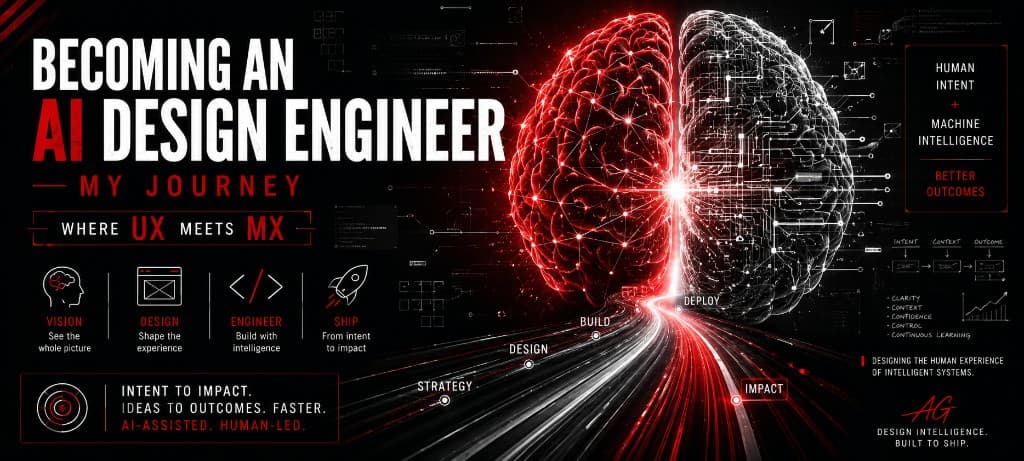
It means I can move from intent to working software without pretending the middle doesn't matter. I still own UX. I still own information architecture. I still own the product story. I just don't wait six months for permission to find out if the idea holds water.
Backline is the proof point: conceived, designed, and shipped to production in 77 days—11 weeks, with me owning vision, design, and AI-assisted execution end to end.

The uncomfortable truth
This path isn't for everyone—and that's fine.
It requires curiosity, tolerance for mess, and enough ego to lead but enough humility to rewrite your own work ten times before lunch.
Takeaway
I'm not becoming less of a designer. I'm becoming the version of designer who can finish the sentence.
If you've spent your career seeing the answer but not building it, AI might be the bridge you've been waiting for. Just don't confuse speed with clarity. You still need both.